Soil conditions shift dramatically across Chandler. In the older neighborhoods near downtown, you'll find dense alluvial sands and gravels deposited by the ancient Salt River. Head south toward the Gila River Indian Community, and you're dealing with finer silts and clays, often with a shallow water table. A CPT sounding picks up these transitions immediately. The cone penetrometer measures tip resistance and sleeve friction every 2 cm, giving us a continuous log. That level of detail is crucial for distinguishing loose sands from compact ones, especially when the site straddles two different soil units. We typically complement this with a resistivity survey to map groundwater salinity, which affects both foundation design and corrosion potential of buried steel.
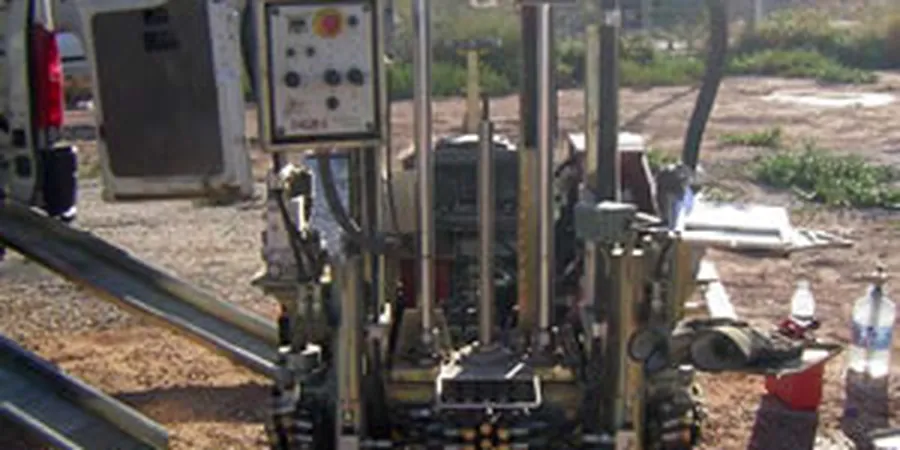
A single CPT sounding in Chandler can distinguish 15 to 20 distinct soil layers, far more than any SPT boring at the same cost.
Methodology and scope
Local considerations
Chandler sits on the Salt River alluvial fan, a sequence of braided stream deposits that vary drastically in compaction. The upper 6 to 10 meters often consist of loose, dry sands and gravels with low cone resistance — below 5 MPa. That's prime territory for differential settlement under strip footings. Below that, you hit older, cemented layers (caliche) that push tip resistance above 30 MPa. The risk? Designing a foundation for the strong layer without accounting for the loose cap. The CPT catches this contrast in a single push. Ignoring it leads to cracked slabs or, worse, punching shear in deep foundations. We've seen it on several Chandler infill projects where the geotechnical report relied solely on SPT blow counts.
Explanatory video
Applicable standards
ASTM D5778-20, IBC 2021 (Chapter 18, Section 1803), ASCE 7-22 (Seismic site classification using CPT-based Vs correlation)
Associated technical services
CPT for shallow foundation design
Continuous profiling down to 20 m for residential slabs and commercial footings. We flag loose zones, caliche layers, and liquefiable horizons. Deliverables include a classified soil profile, bearing capacity estimates per Terzaghi, and settlement predictions.
CPT for deep foundation and seismic analysis
Extended pushes to 45 m for drilled shafts or driven piles. Pore pressure dissipation tests measure coefficient of consolidation (cv). Liquefaction triggering analysis per Idriss & Boulanger 2008 using the CPT-based method.
Typical parameters
Frequently asked questions
How does CPT differ from SPT for Chandler soils?
CPT provides a continuous profile at 2 cm intervals, while SPT gives discrete blow counts every 1.5 m. In Chandler's variable alluvium, the CPT catches thin clay lenses and loose pockets that the SPT might skip entirely. The CPT also measures pore pressure, which helps identify confined aquifers before excavation.
What is the typical depth range for CPT in Chandler?
We routinely push to 30-40 meters in the valley fill. Refusal usually occurs when the cone hits cemented caliche layers at 15-25 m or dense gravels exceeding 50 MPa. For shallow foundation work, we stop at 15 m unless the soil profile suggests deeper weak zones.
Can CPT detect liquefaction risk in Chandler?
Yes. The CPT-based method (Robertson & Wride 1998) is the preferred screening tool per IBC 2021. We use cone resistance and soil behavior type to compute the cyclic resistance ratio (CRR). In Chandler, the primary concern is loose, saturated sands below the water table, which occur locally near irrigation canals and the Gila River corridor.
How much does a CPT sounding cost in Chandler?
A standard 20 m push runs between $180 and $260, depending on access and depth. The price includes mobilization within Chandler city limits, data acquisition, and a basic soil behavior type report. Deeper pushes or additional pore pressure dissipation tests carry an extra charge.
What certifications does your CPT equipment hold?
Our cone penetrometers are calibrated annually to ASTM D5778-20 using a certified load cell and pressure transducer. The entire data acquisition system is traceable to NIST. We also maintain ISO 9001:2015 accreditation for our field and laboratory procedures.