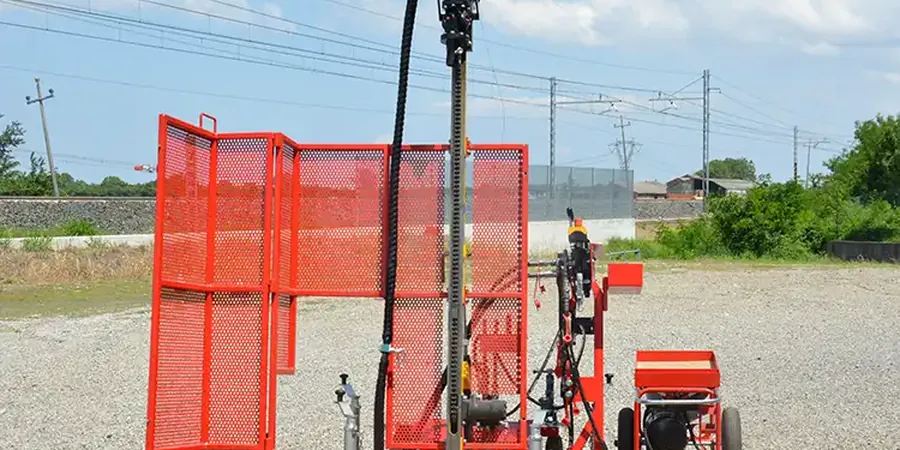
We pull up to your Chandler site with a CME 55 drill rig mounted on a Ford F-550, the split-spoon sampler already greased and ready. The crew sets the cathead at the correct drop height — 30 inches per ASTM D1586 — and runs the 140-pound hammer through its sequence. Each blow count is recorded on a field log that later gets cross-checked against our laboratory data. This is the same procedure we follow for subdivisions near Ocotillo Road and for commercial lots along the 202 loop. Before we deploy the SPT, we often review existing nearby logs to correlate our upcoming N-values with known Chandler stratigraphy. When the soil profile includes cemented caliche layers, we switch to a carbide-tipped sampler; for loose sands we rely on a liner to retain the sample. Every run is photographed and catalogued. The entire operation is supervised by a geotechnical engineer who verifies that the blow counts are consistent and that the drilling fluid return is adequate. We also coordinate with the general contractor to keep the site clean and safe throughout the day.
In southern Chandler, SPT blow counts below 15 signal loose silts that require deeper foundations or ground improvement before any slab is poured.
Methodology and scope
Local considerations
Chandler sits at roughly 1,200 feet elevation on ancient alluvial fans from the Salt River. The groundwater table is deep — typically 80 to 120 feet below grade in the northern half — but drops to 30 feet near the southern edge. The main geotechnical risk here is not water; it is the caliche. These cemented calcium carbonate layers can be 6 to 18 inches thick and produce SPT blow counts that spike to 60 or more, making the underlying loose sand look far stiffer than it really is. If we misinterpret that spike as competent bearing material, the foundation could settle unevenly once the caliche cracks under load. We handle this by drilling through the caliche and running a second SPT in the material below, then comparing values to confirm the profile. The other risk is the loose silty sand in the southern floodplain; an uncorrected N-value of 8 there can trigger a liquefaction analysis that changes the entire foundation scheme. We flag that in the report and coordinate with the structural engineer before any footing design starts.
Applicable standards
ASTM D1586-18 – Standard Test Method for SPT, ASTM D2488-17 – Description and Identification of Soils (USCS), IBC 2018 – Section 1806 (Bearing Capacity and SPT), ASCE 7-16 – Chapter 11 (Seismic Site Class from N-values)
Associated technical services
Standard SPT Boring (0–50 ft)
Single boring with SPT every 5 ft to refusal or 50 ft. Includes field logs, blow counts, sample recovery, and a summary table of N-values with energy correction. Suitable for residential slabs and light commercial pads. Report delivered within 5 business days.
Advanced SPT with Seismic Interpretation
SPT borings to 100 ft with downhole P-S suspension logging. N-values are correlated to VS30 for seismic site classification per ASCE 7-16. Includes liquefaction screening using the Youd-Idriss 2001 method. Recommended for schools, hospitals, and structures in Seismic Design Category D.
Typical parameters
Frequently asked questions
How is the SPT performed in Chandler's caliche layers?
When the split-spoon sampler encounters cemented caliche, we stop the standard drive and switch to a rotary coring bit to penetrate the layer. Once through, we resume the SPT drive in the underlying soil. The blow count through the caliche is recorded separately and flagged in the report as a cemented zone, not a bearing stratum.
What is the typical SPT N-value range for residential lots in Chandler?
In the northern half of Chandler (north of Chandler Boulevard), N-values typically range from 25 to 45 in the dense sands and gravels. In the southern floodplain, values drop to 8–18 in the loose silty sands. The transition zone near Dobson and Germann shows values of 15–25, reflecting the mixed alluvial fan deposits.
How much does an SPT investigation cost for a Chandler home?
A standard SPT boring to 50 ft costs between US$530 and US$770, depending on site access and the number of borings. The price includes mobilization within Chandler, the field test per ASTM D1586, and a summary report with corrected N-values. Multiple borings reduce the per-boring cost.
Can SPT results be used to determine seismic site class for Chandler?
Yes. The corrected N60 values from SPT are used directly to assign the site class per ASCE 7-16 Table 20.3-1. For a typical Chandler profile with N60 > 50 in the upper 100 ft, the site class is C (very dense soil). For southern Chandler with N60 below 15, the site class shifts to D (stiff soil), which triggers a different response spectrum for the structural design.