The backhoe excavator we deploy for subsurface access in Chandler typically works within the first 4.5 meters of the Sonoran alluvium, a mix of silty sands and gravelly clays deposited by ancient washes. This depth is enough to expose the soil profile that directly controls lateral earth pressures on any proposed retaining structure. For a typical residential or commercial retaining wall design in Chandler, the team logs each stratum in accordance with ASTM D2488 and collects undisturbed samples for direct shear and triaxial testing. Before finalizing the structural reinforcement, we correlate the friction angle and unit weight data with site-specific groundwater observations to avoid overestimating passive resistance. The methodology follows a phased approach: initial reconnaissance, test pit excavation, field density checks, and laboratory classification. Each layer's stiffness is measured using a plate load test where the wall height exceeds 2.5 meters, ensuring the foundation soil can support the applied bearing loads without excessive rotation.
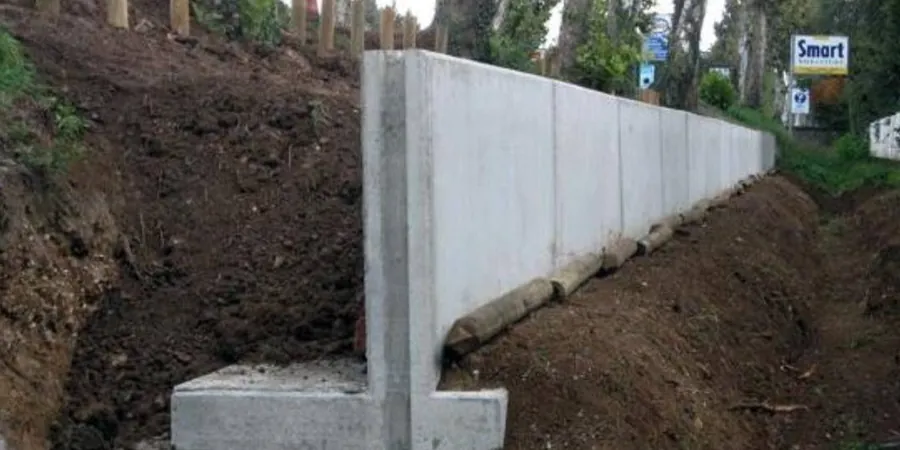
Lateral earth pressures in Chandler's alluvium are dominated by the friction angle of silty sands, not the cohesion of clays.
Methodology and scope
- Effective friction angle (phi'): 28-34 degrees depending on fines content
- Cohesion intercept (c'): 0-50 psf for granular fills, up to 200 psf for overconsolidated clays
- Unit weight: 105-125 pcf in the natural state
- Modulus of subgrade reaction: 80-200 pci for wall footing design
Local considerations
A common mistake among contractors in Chandler is assuming the alluvial sand is free-draining and ignoring perched water tables after the summer monsoons. Without a proper drainage layer and weep holes, hydrostatic pressure can double the lateral load on a retaining wall design, leading to tilting or complete failure within two rainy seasons. Another frequent error is using a single soil friction angle for the entire wall height when the upper 1.5 meters may be loose fill and the lower 2.0 meters is dense cemented gravel. The geotechnical report must specify separate parameters for each stratum, and the structural engineer should check sliding and overturning at the interface between layers. A wall designed with uniform soil properties across a layered profile may satisfy the global factor of safety but fail locally at the weak zone.
Applicable standards
ASCE 7-22 Minimum Design Loads and Associated Criteria for Buildings and Other Structures, AASHTO LRFD Bridge Design Specifications (9th Edition, 2020) – Section 11: Abutments, Piers, and Walls, ACI 318-19 Building Code Requirements for Structural Concrete – Chapter 15: Footings and Retaining Walls, ASTM D2487-17 Standard Practice for Classification of Soils for Engineering Purposes
Associated technical services
Lateral Earth Pressure Analysis
We calculate active, at-rest, and passive pressures using Rankine and Coulomb theories, calibrated with site-specific phi' and c' values from direct shear tests. The analysis includes surcharge loads from adjacent structures, traffic, or stockpiles, and considers both static and seismic conditions per ASCE 7.
Drainage and Backfill Specification
A chimney drain of 1.5-inch clean gravel wrapped in non-woven geotextile is designed behind the wall stem, connected to a 4-inch perforated pipe at the base. We specify the required hydraulic conductivity (k > 0.1 cm/s) and filter compatibility with the native silty sand to prevent piping.
Seismic Wall Stability Check
Using the site-specific SPT N-values and shear wave velocity from our MASW survey, we compute the seismic coefficient (kh = 0.5 PGA) and check sliding, overturning, and bearing capacity under the design earthquake (MCEr). The factor of safety for sliding is kept above 1.5 under seismic loading.
Typical parameters
Frequently asked questions
What soil conditions in Chandler most affect retaining wall design?
The alluvial silty sands and gravelly clays of the Sonoran alluvium dominate. The primary concern is the friction angle of the granular layers (28-34 degrees) and the potential for perched water after monsoon rains. Caliche layers can provide high passive resistance but also create a hard digging surface that affects wall embedment.
How much does a geotechnical investigation for a retaining wall in Chandler cost?
The typical range for a full investigation including test pits, laboratory testing, and a design report is US$1,170 to US$4,460, depending on wall length, number of soil strata, and the need for seismic analysis. A simple residential wall on a single soil layer falls at the lower end; a tall commercial wall with complex layering requires the upper range.
Do I need a seismic check for a retaining wall in Chandler?
Yes, because Chandler lies in Seismic Design Category C per the 2021 IBC with a mapped spectral acceleration Ss between 0.5g and 0.75g. Any wall retaining more than 1.8 meters of soil must be checked for seismic lateral earth pressure using the Mononobe-Okabe method. The geotechnical report includes the seismic coefficient and the design ground motion parameters.
What drainage is recommended behind a retaining wall in Chandler's climate?
A granular chimney drain of 1.5-inch clean gravel, wrapped in non-woven geotextile, connected to a 4-inch perforated PVC pipe at the base. The drain must extend the full height of the wall and outlet to a free-draining daylight or a sump pump. Without this, the monsoonal rains (average 7 inches annually, mostly July-September) will saturate the backfill and double the lateral pressure.