Chandler grew fast from farmland into one of the largest suburban cities in the Phoenix metro area. That rapid development meant large tracts of land were regraded and filled before construction. Many residential and commercial lots sit on engineered fills that vary in thickness and compaction. Without a targeted foundations on fill analysis, differential settlement becomes a real risk for slabs and strip footings. The local alluvial geology, with deep sand and gravel deposits, adds another layer of complexity. We combine site-specific exploration with laboratory testing to assess fill behavior under load. For shallow fills we often correlate results with a plate load test to verify modulus of subgrade reaction directly on the compacted surface.
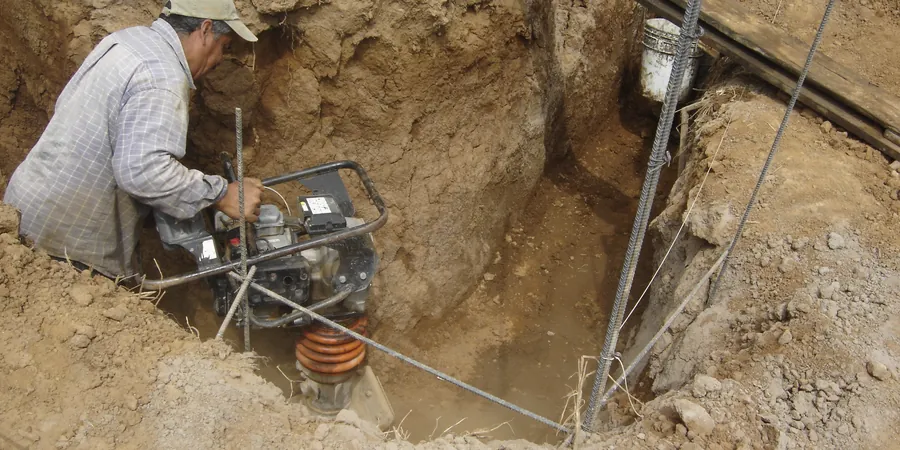
A fill that passes compaction tests can still collapse under load if its metastable structure is not identified through proper laboratory consolidation testing.
Methodology and scope
- Review of compaction records and field density tests per ASTM D6938
- Boreholes or test pits to verify fill thickness and uniformity
- Laboratory consolidation tests on fill samples to predict long-term settlement
Local considerations
A common mistake in Chandler is assuming that all fills are the same. Builders sometimes rely only on compaction reports from the grading contractor and skip a proper foundations on fill analysis. That can lead to surprises: a fill that passed density tests may still have variable moisture content or hidden layers of uncompacted material. When the monsoon rains come, differential settlement can crack slabs and tilt foundations. We have seen cases where a 6-inch slab settled 2 inches in one corner because the fill below was never tested for collapse potential. A thorough analysis identifies these risks before concrete is poured.
Applicable standards
IBC 2021 Chapter 18 (Soils and Foundations), ASCE 7-16 (Minimum Design Loads for Buildings), ASTM D5333 (Collapse Potential of Soils)
Associated technical services
Fill Verification & Settlement Analysis
Boreholes and test pits to confirm fill geometry, compaction quality, and material type. Includes consolidation testing and settlement predictions for shallow foundations on compacted fill.
Collapse Potential Assessment
Double-odometer consolidation tests per ASTM D5333 to evaluate collapse upon wetting. We provide collapse index values and recommendations for mitigation such as pre-wetting or deep dynamic compaction.
Typical parameters
Frequently asked questions
What is the difference between a compaction test and a foundations on fill analysis?
A compaction test (like ASTM D698) measures in-place density and moisture content during fill placement. A foundations on fill analysis goes further: it evaluates the fill's long-term behavior under structural loads, including consolidation settlement, collapse potential, and variability across the site.
How much does a foundations on fill analysis cost in Chandler?
The typical cost ranges from US$840 to US$2,670 depending on the number of borings, lab tests required, and site accessibility. A basic analysis for a single-family lot with two test pits and consolidation testing falls at the lower end, while a commercial site with multiple borings and collapse testing reaches the higher end.
Can I build on a fill that was placed 10 years ago?
Yes, but the fill must be re-evaluated. Older fills may have settled naturally, but they can also develop hidden issues like moisture migration or biological decomposition of organic inclusions. A new foundations on fill analysis with borings and lab testing is recommended before any structural load is applied.
What if the fill is only 3 feet deep and I want a slab-on-grade?
A 3-foot fill can support a slab-on-grade if it is well-compacted and has low collapse potential. However, the analysis must include a plate load test or CBR test to verify the subgrade modulus. We also check for underlying native soils that may settle differently than the fill.