Chandler sits on a mix of deep alluvial deposits and older basin-fill sediments typical of the Salt River Valley. Groundwater sits well below typical foundation depth, but the near-surface soils often include loose sands, silty clays, and occasional caliche layers. These conditions can produce consolidation or collapse settlement under moderate loads. When we assess settlement in Chandler, we first retrieve undisturbed tube samples for oedometer testing, then model the load-settlement curve using parameters like Cc and Cr. If the site has fill or undocumented compaction, we also run a placa de carga to verify stiffness at working stress levels. That field check directly validates our lab predictions before foundation design moves forward.
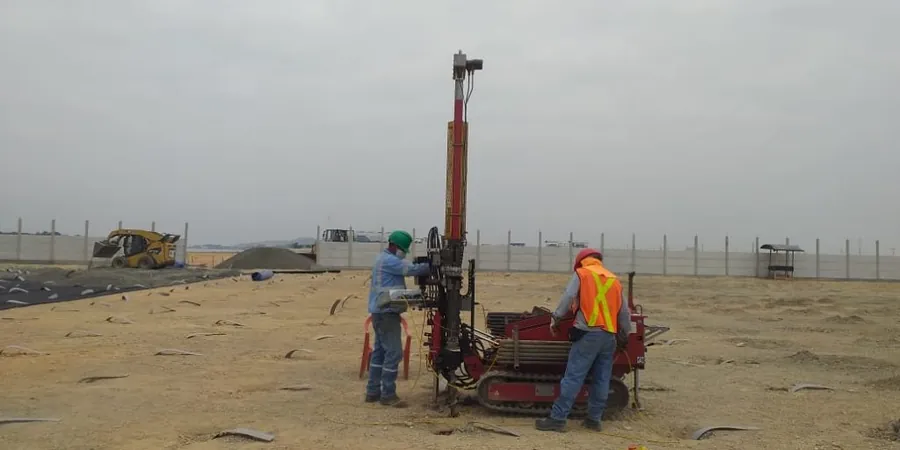
In Chandler’s alluvial soils, differential settlement from undocumented fill can exceed 1.5 inches if compaction is not verified before foundation construction.
Methodology and scope
Local considerations
Chandler grew rapidly from farmland into a suburban city over the last three decades. Many residential parcels were leveled with on-site soils and never mechanically compacted. That legacy fill now sits under new homes, parking lots, and light commercial slabs. If a settlement analysis skips the fill layer or assumes native soil parameters, the risk of post-construction consolidation jumps significantly. We always pair the lab work with field verification — especially when we see old drainage channels or former agricultural ditches that were backfilled without control.
Applicable standards
ASTM D2435 – Standard Test Methods for One-Dimensional Consolidation Properties of Soils, ASTM D4546 – Standard Test Methods for One-Dimensional Swell or Collapse of Soils, IBC 2018 – Section 1803.5.4 (settlement and heave evaluation), ASCE 7-16 – Minimum Design Loads for Buildings and Other Structures (allowable foundation movement)
Associated technical services
One-Dimensional Consolidation Testing (Oedometer)
Incremental load oedometer tests per ASTM D2435 on undisturbed samples. We determine Cc, Cr, and σ'p for total and differential settlement estimates. Results include time-rate curves for consolidation duration.
Collapse Potential Testing
Double-oedometer tests on dry and inundated samples to quantify collapse settlement in loose alluvial or fill soils. Common in Chandler’s old agricultural zones where soil moisture history is uncertain.
Typical parameters
Frequently asked questions
What is the typical cost range for settlement analysis in Chandler?
For a standard residential or light commercial project in Chandler, settlement analysis including sampling, oedometer testing, and reporting typically ranges between US$580 and US$1,860. The final cost depends on the number of test depths and the complexity of the soil profile.
How do you differentiate between immediate settlement and creep in Chandler's soils?
Immediate settlement is calculated using elastic theory from SPT blow counts and unconfined compression tests on intact samples. Creep, or secondary compression, is evaluated from the slope of the consolidation curve beyond the primary consolidation phase. In Chandler's silty clays, creep becomes significant when the clay fraction exceeds 30% and the plasticity index is above 20.
Do you need a settlement analysis if the building has deep foundations?
Yes. Even deep foundations can experience settlement from negative skin friction or consolidation of underlying soft layers. For piles or drilled shafts in Chandler, we still run oedometer tests on the bearing stratum and any compressible layers above it to verify that total and differential movements stay within IBC limits.