Chandler’s alluvial soils, deposited by ancient floodplains of the Gila River, create a challenging profile of interbedded clays, silts, and sands. The shallow groundwater table, typically 10–15 ft deep, saturates much of the clay layer. For rapid strength assessment of these cohesive strata, the unconfined compression test (UCS) provides a direct measure of undrained shear strength without the need for confining pressure. Before interpreting results, however, the lab first runs a clasificación de suelos to confirm the material classifies as CH or CL under ASTM D2487. This baseline ensures the UCS value is valid for that specific soil type.
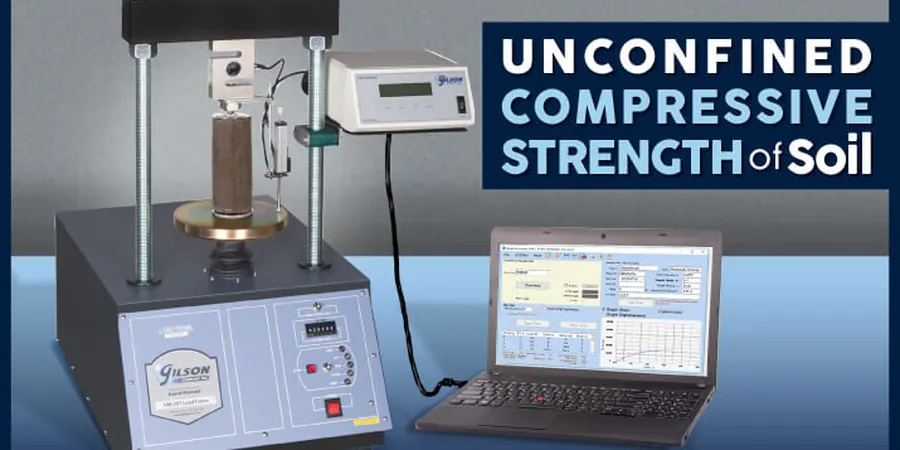
For Chandler’s fat clays, a single UCS test can save days of triaxial setup while still giving reliable undrained strength for preliminary bearing capacity.
Methodology and scope
- Unconfined compressive strength (qu)
- Undrained shear strength (su = qu/2)
- Stress-strain curve and failure strain
- Moisture content at test time
- Unit weight of the specimen
Local considerations
Soils in the Ocotillo area of Chandler often show higher plasticity indices (PI > 40) compared to the drier, sandier profiles near the Price Road corridor. Applying a UCS value from a low-PI zone to a high-PI zone can overestimate strength by 30% or more. In Chandler, where expansive clays cause differential heave in slabs, using an unconfined compression test from the wrong stratum leads to undersized footings. Always match the UCS sample depth and moisture content to the actual bearing layer.
Applicable standards
ASTM D2166-16, ASTM D2487-17, ASTM D1587-15 (thin-walled tube sampling)
Associated technical services
Thin-walled tube sampling
Hydraulic push of 3-in Shelby tubes to obtain undisturbed specimens for UCS and other strength tests. Depth accuracy ±0.1 ft.
Moisture content & density profiling
Oven-dry method per ASTM D2216 and unit weight determination on each UCS specimen. Essential for interpreting strength variations.
Unconsolidated-undrained triaxial (UU)
Multi-stage UU test for projects requiring strength at multiple confining pressures. Directly applicable for slope stability in Chandler’s canal embankments.
After-failure soil classification
Post-test Atterberg limits and grain-size analysis on the failed specimen. Links the UCS result to the soil’s plasticity and gradation.
Typical parameters
Frequently asked questions
What is the difference between UCS and unconsolidated-undrained (UU) triaxial test?
UCS applies no confining pressure and is run on a single specimen. UU triaxial tests multiple specimens at different cell pressures, giving a failure envelope. UCS is faster and cheaper for preliminary screening of Chandler clays.
How much does an unconfined compression test cost in Chandler?
The typical range for a single UCS test in Chandler is US$350 – US$540, depending on sample preparation, number of specimens, and reporting detail. Volume discounts may apply for multiple samples from the same project.
Can UCS be used for sandy soils found in Chandler?
No. UCS is only valid for cohesive soils (clays and silts) that can stand without confining pressure. Chandler’s clean sands require direct shear or triaxial tests to determine shear strength.
How long does it take to get UCS results for a Chandler project?
Typically 3–5 business days from sample delivery. Urgent projects can be expedited to 48 hours at a small surcharge. The stress-strain curve and failure photos are included in the report.
Does the lab need to be accredited for UCS testing?
Yes. We perform UCS under ASTM D2166 in a laboratory accredited to ISO 17025. Accreditation ensures the loading frame calibration, strain rate control, and data recording meet national standards.