Chandler sits at roughly 1,200 feet above sea level on the alluvial plain of the Salt River Valley, where the subsurface profile typically consists of interbedded sands, silts, and gravels with occasional clay lenses. For over 200 miles of arterial roads and countless parking lots, the existing pavement evaluation becomes the first technical gate before any overlay or reconstruction decision. We combine falling weight deflectometer readings with laboratory classification and subrasante vial stiffness assessment to determine remaining structural life. The seasonal variation in moisture content here, driven by monsoon rainfall from June to September, demands a testing window that captures both dry and wet response. Without that seasonal correction, design assumptions on modulus values can be off by 30 percent or more, leading to premature cracking or excessive thickness.
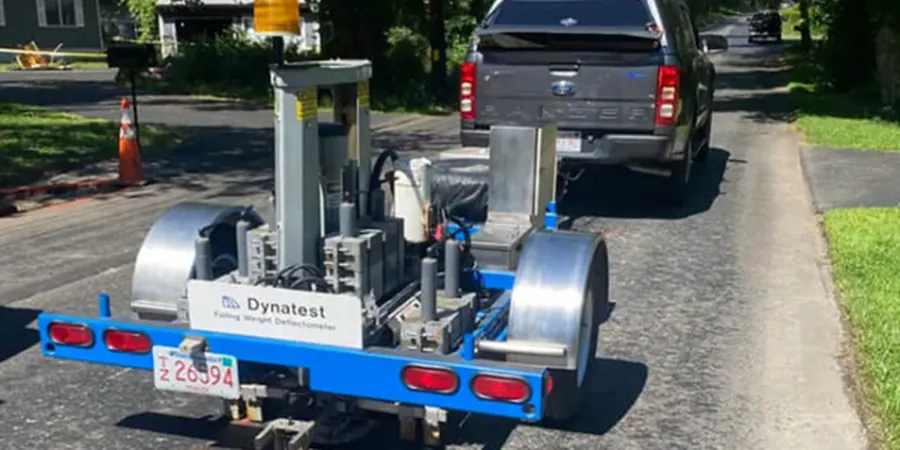
Monsoon moisture can reduce subgrade modulus by 30 percent; testing must capture both dry and wet response for reliable overlay design.
Methodology and scope
- Falling weight deflectometer (FWD) testing per ASTM D4694 to back-calculate layer moduli
- Core extraction for thickness verification and laboratory density
- Dynamic cone penetrometer (DCP) profiling for unbound base and subgrade strength
Local considerations
The difference in alluvial fan deposition between the western edge of Chandler near the Gila River Indian Community and the higher ground around Ocotillo Road can produce subgrade CBR values that vary by a factor of three within the same project boundary. An existing pavement evaluation that relies on a single test pit per mile, common in low-budget scopes, will miss these transitions entirely. The risk is a 200-meter stretch of pavement that fails in the first wet season because the base layer was designed for a modulus that never existed there. We address this by spacing FWD tests at 50-meter intervals and running DCP checks at every transition zone. This density of investigation is what separates a forensic-level evaluation from a compliance check. Ignoring the lateral variability in Chandler's alluvial soils guarantees differential settlement in the pavement profile within two to three years.
Applicable standards
ASTM D4694: Standard Test Method for Deflections with a Falling Weight-Type Impulse Load Device, ASTM D6951: Standard Test Method for Use of the Dynamic Cone Penetrometer in Shallow Pavement Applications, ASTM D1586: Standard Test Method for Standard Penetration Test (SPT) and Split-Barrel Sampling, AASHTO T 307: Determining the Resilient Modulus of Soils and Aggregate Materials
Associated technical services
FWD Structural Evaluation
Falling weight deflectometer testing at 50 m spacing with backcalculation of layer moduli using ELMOD or EVERCALC software. We provide deflection basin parameters and remaining life estimates for flexible and composite pavements.
Coring & Laboratory Characterization
Extraction of 100 mm diameter cores for thickness verification, laboratory density, and extraction for binder content. Unbound base and subgrade samples undergo classification, Proctor compaction, and CBR testing per ASTM standards.
Typical parameters
Frequently asked questions
How does the existing pavement evaluation differ from a routine geotechnical investigation?
A pavement evaluation focuses on the structural capacity and layer properties of the existing pavement system — surface, base, and subgrade — using FWD, coring, and DCP. A routine geotechnical investigation targets deeper soil profiles for foundation design. Both are complementary but serve different design stages.
What is the typical cost range for a pavement evaluation in Chandler?
The cost depends on project size and testing density. For a typical 1-mile section with FWD testing at 50 m spacing and 4 cores, the range is US$1,100 to US$3,270. Larger projects with more test points and laboratory work fall at the upper end of that range.
At what stage of a road project should the evaluation be performed?
Ideally before the preliminary design phase, so that the rehabilitation strategy — overlay thickness, milling depth, or full reconstruction — is based on actual layer moduli and remaining life. Waiting until the final design stage often forces conservative assumptions that increase costs unnecessarily.
Can you evaluate pavements with cement-treated or stabilized bases?
Yes. Cement-treated bases require careful interpretation of FWD deflection basins because the treated layer exhibits higher stiffness but can be brittle. We apply modified backcalculation procedures that account for cracking patterns in the CTB and adjust the modulus accordingly.