Chandler's rapid growth from agricultural fields to master-planned communities has reshaped its subsurface demands. The city sits over deep alluvial deposits from the Santa Cruz River, with sandy loams and silty layers dominating the upper 30 feet. For containment systems, from stormwater detention basins to industrial liners, specifying the right geomembrane thickness, polymer type, and seam strength is critical. A rigorous geomembrane specification process must account for UV exposure in the Sonoran Desert and potential puncture from angular gravel native to the area. Before selecting a liner, teams often combine a resistivity survey to map preferential flow paths in the subgrade.
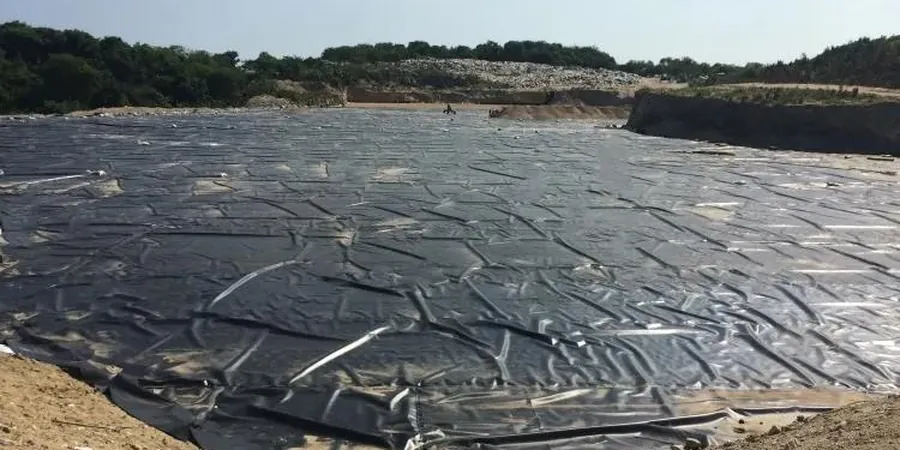
A failed geomembrane in Chandler's arid climate often traces back to subgrade puncture from untreated caliche nodules, not the liner material itself.
Methodology and scope
- Thickness: 40 to 80 mil (1.0–2.0 mm), depending on exposure and puncture resistance
- Carbon black content: 2.0–3.0% per ASTM D1603 for UV stability
- Seam peel adhesion: minimum 70 lb/in width per NSF 54
Local considerations
A common scenario on Chandler construction sites involves uncovering undocumented caliche layers during subgrade grading. This indurated calcium carbonate can punch through a 40-mil HDPE geomembrane within hours of placement if the cushion geotextile is underspecified. The team uses a heavy 8 oz/sy nonwoven geotextile as a puncture layer, then validates the assembly with a field seam peel test. Skipping this step on a Chandler detention basin has led to costly liner replacement during the monsoon season, when stormwater infiltrates undetected below the liner and erodes the subgrade.
Applicable standards
GRI-GM13 (HDPE geomembrane standard), ASTM D5199 (thickness measurement), ASTM D6392 (seam strength), NSF 54 (flexible membrane liners)
Associated technical services
Material Selection & Testing
Laboratory index testing per GRI-GM13: density, tensile, tear, puncture, and carbon black dispersion. We verify manufacturer certificates against project specs.
Field Seam QC & CQA
On-site destructive seam sampling, air pressure testing for dual-track seams, and daily CQA reports. Chandler crews follow IAGI guidelines for installation.
Subgrade Evaluation & Cushion Design
Plate load tests (ASTM D1196) and cone penetrometer soundings to classify subgrade stiffness. We specify geotextile weight and geomembrane thickness accordingly.
Typical parameters
Frequently asked questions
What is the difference between HDPE and LLDPE geomembrane for Chandler soils?
HDPE offers higher tensile strength (≥44 kN/m) and chemical resistance, making it the standard for Chandler's detention basins and industrial ponds. LLDPE (linear low-density) provides greater elongation (>700%) and conforms better to irregular subgrades with caliche nodules. The choice depends on puncture risk and exposure: HDPE for UV-exposed slopes, LLDPE for buried liners in aggressive subgrade.
How much does a geomembrane specification study cost in Chandler?
A typical specification project—including material index testing, subgrade evaluation, and a written CQA plan—ranges from US$640 to US$1,570. The final cost depends on the number of polymer types evaluated, seam peel tests required, and whether full-scale field destructive sampling is included.
What seam testing method is required for geomembrane liners in Chandler?
The most common method is destructive shear and peel tests per ASTM D6392, with a minimum peel adhesion of 70 lb/in width for 60-mil HDPE. For field QC, non-destructive air pressure testing at 30 psi for dual-track fusion seams is standard. The Chandler municipal stormwater guidelines also require vac-box testing on all accessible seams before cover placement.
Can a geomembrane be installed over Chandler's caliche subgrade?
Yes, but only after subgrade preparation: removal of loose material, compaction to 95% of standard Proctor, and placement of a 8 oz/sy nonwoven geotextile as puncture cushion. If caliche nodules larger than 1.5 inches remain, they must be excavated or crushed. A subgrade plate load test (ASTM D1196) confirms modulus >14 MPa before deployment.