The difference between building on the consolidated alluvium near downtown Chandler versus the loose sandy deposits west of the Gila River Indian Community is night and day. In the older, denser soils around Arizona Avenue, seismic waves travel faster and amplify less. But out near the Sun Lakes area, those young, unconsolidated sediments can trap energy and double the ground motion at certain frequencies. That is why we run site-specific seismic amplification analysis before designing any mid-rise or critical facility in Chandler. The city sits on deep basin fill that responds differently to shaking than the hard rock sites further north. Without this study, you are guessing at design spectra. We combine Vs30 measurements with a resistivity survey to map soil layering across the property and define realistic amplification factors.
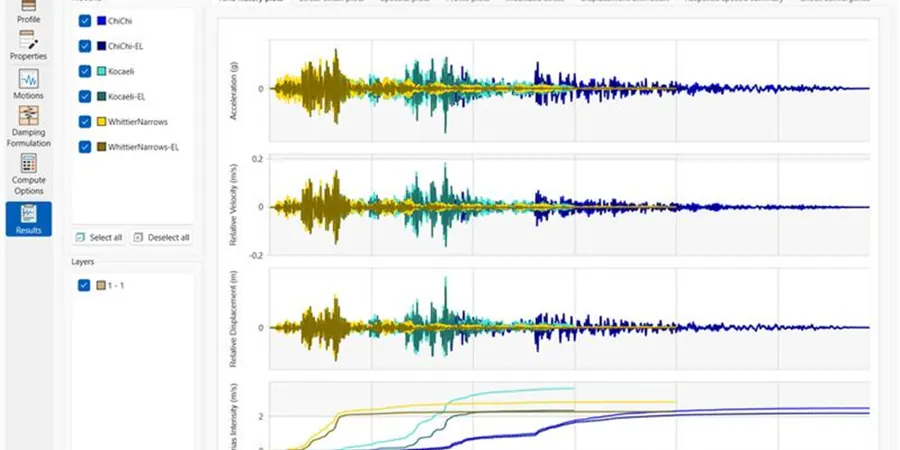
We deploy a portable seismograph array and record ambient vibrations for at least two hours per station to determine the fundamental site frequency.
Methodology and scope
Local considerations
We use a three-component seismometer sensitive enough to detect microtremors below 0.1 Hz. The sensor sits on a spike coupled directly to the ground — no base plate. In Chandler's dry, compacted fill, we often need to pre-wet the contact point to get good coupling. Cables run 30 meters to a 24-bit digitizer powered by a deep-cycle battery. The whole setup fits in a single Pelican case. We deploy it at dawn to avoid traffic noise from the 101 and 202 freeways. Each station records for two hours minimum. The raw time series gets processed through a Fourier transform to isolate the soil column's resonant peaks.
Explanatory video
Applicable standards
ASCE 7-22 (Section 11.4 – Site Class Determination), ASTM D4428/D4428M-14 (Crosshole Seismic Testing), NEHRP Recommended Seismic Provisions (Site Amplification Factors)
Associated technical services
Ambient Vibration HVSR Survey
Passive seismic method using three-component sensors to record background noise. Data is inverted to obtain the soil column's fundamental frequency and impedance contrast. Ideal for preliminary site classification and single-family to mid-rise projects in Chandler. Delivers Vs30 estimates with ±15% uncertainty.
Active MASW with Inversion
Multi-channel analysis of surface waves using a sledgehammer source and 24-geophone array. Provides a 1D shear wave velocity profile down to 30-40 meters depth. Higher resolution than HVSR alone. Recommended for schools, hospitals, and buildings in Seismic Design Category D or above in Chandler.
Typical parameters
Frequently asked questions
Why is seismic amplification analysis needed in Chandler when we are not near a major fault?
Chandler sits on deep alluvial deposits that can amplify ground motion from distant earthquakes on the San Andreas or other regional faults. The soil column acts like a bowl of jelly — low-frequency waves get trapped and amplified. Without site-specific analysis, you end up using conservative code spectra that may either overestimate or underestimate the actual demand. The risk is real even if the epicenter is 200 miles away.
What is the difference between NEHRP site class and site-specific amplification factors?
NEHRP site class (A through F) gives you a single amplification factor based on the average Vs30. Site-specific analysis goes further. It considers the full velocity profile, the depth to bedrock, and the impedance contrast between layers. Two properties both classified as Site Class D can have very different amplification patterns. One may amplify at 1 Hz, the other at 3 Hz. Your building's natural period interacts with that frequency. Site-specific analysis catches that mismatch.
How much does a seismic amplification study cost for a typical Chandler residential lot?
For a standard residential lot (0.25 acre), an HVSR survey with three stations runs between US$1,060 and US$2,240. That includes equipment deployment, data processing, and a report with site class and recommended design spectra. Larger commercial parcels with active MASW will be on the higher end. The price scales with the number of stations and the need for borehole correlation.
Can you combine amplification analysis with existing geotechnical boring data?
Yes, and we strongly recommend it. If you already have SPT borings on site, we can calibrate the shear wave velocity profile against the blow counts using established correlations (Ohta & Goto, Seed & Idriss). That gives you a hybrid model that is more reliable than either method alone. We integrate the data into our inversion algorithm and produce a unified site response model for the structural engineer.