Chandler soils range from silty sands to expansive clays, making compaction control critical before any slab or pavement. Our Proctor test follows ASTM D698 for Standard effort and ASTM D1557 for Modified effort, both essential to define the maximum dry density and optimum moisture content. Chandler’s alluvial deposits often require the Modified method to simulate heavier roller loads. Before placing fill, we also recommend a site compaction control with density cone to verify field results against the lab curve. The Proctor curve becomes the baseline for every compaction specification in the city.
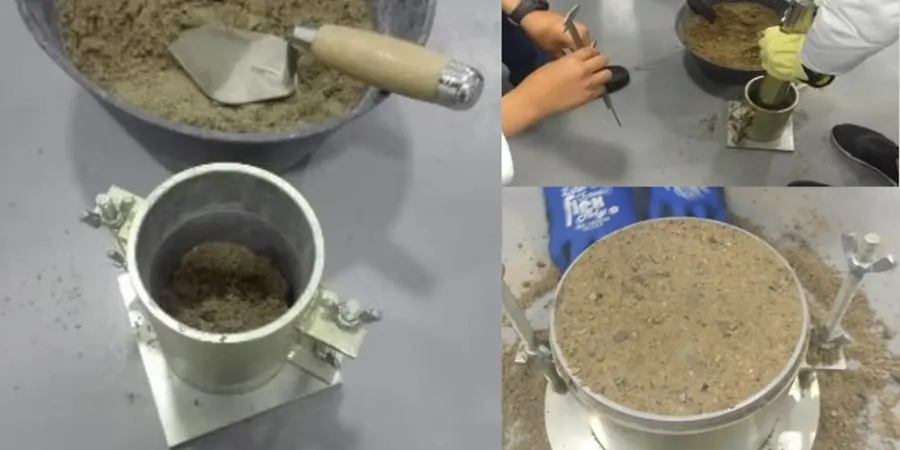
For Chandler’s desert soils, the Modified Proctor test gives a more realistic target for heavy compaction equipment used in commercial developments.
Methodology and scope
Local considerations
In Chandler’s southeastern neighborhoods, soils contain more clay and require higher moisture to reach optimum. Over in the Ocotillo area, sandy loams dominate and compact fast, but they can dry out before the roller passes. If the Proctor curve is not properly defined, you risk placing fill at 90% relative compaction when 95% was specified. That leads to differential settlement under slabs. The difference between Standard and Modified Proctor can shift the target dry density by 5 to 8 pcf, so choosing the wrong method means failing field tests all week.
Applicable standards
ASTM D698-12e2 (Standard Proctor), ASTM D1557-12e1 (Modified Proctor), IBC 2021 Chapter 18 – Excavation, Grading and Fill, AASHTO T-99 / T-180
Associated technical services
Standard Proctor (ASTM D698)
For light compaction work – residential slabs, walkways, and shallow fill. Uses the 5.5-lb hammer and 12-inch drop. We return the maximum dry density and optimum moisture content within 48 hours.
Modified Proctor (ASTM D1557)
For heavy compaction – highways, airport aprons, and commercial pads. The 10-lb hammer and 18-inch drop simulate high-energy rollers. Essential for Chandler’s larger earthwork jobs.
Field Verification Package
We match the lab Proctor curve with field density tests using sand cone or nuclear gauge. Includes on-site technician support and a summary report comparing field results to the lab target.
Typical parameters
Frequently asked questions
What is the difference between Standard and Modified Proctor test?
The Standard Proctor (ASTM D698) uses a 5.5-lb hammer dropped 12 inches with 3 or 5 lifts. The Modified Proctor (ASTM D1557) uses a 10-lb hammer dropped 18 inches with 5 lifts. The Modified method applies about 4.5 times more compactive energy, producing a higher maximum dry density and a lower optimum moisture content.
How much does a Proctor test cost in Chandler?
A Standard Proctor test typically ranges from US$110 to US$180 per sample. The Modified Proctor test runs between US$150 and US$220. The final price depends on the number of points required and whether the sample needs drying or crushing before testing.
How long does it take to get Proctor test results?
Standard turnaround is 2 to 3 business days from sample receipt. The test itself takes about 4 to 6 hours per sample, but we need time to dry the material and plot the compaction curve. Rush service is available for an additional fee.
Do I need a Proctor test for every soil type on site?
Yes, if you have two or more distinct soil types in the cut or borrow area. Each material has its own compaction curve. Using one curve for all fills can lead to low density readings and failed compaction reports. We can help you identify the different layers before sampling.