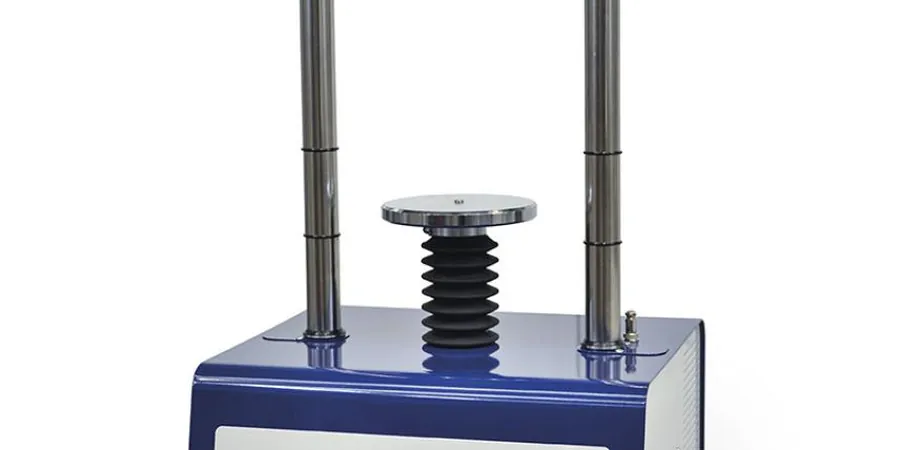
The triaxial test equipment used in Chandler typically consists of a loading frame capable of 50 kN, a cell pressure system with precision regulators, and digital data acquisition. Specimens are 71 mm in diameter and trimmed from thin-walled tube samples recovered during drilling. Chandler's arid climate means samples are often dry, so saturation control using back-pressure is critical to obtain reliable effective stress parameters. The test program follows ASTM D2850 for unconsolidated undrained (UU) and ASTM D4767 for consolidated undrained (CU) with pore pressure measurement. Before running the triaxial, the team often reviews the soil classification from granulometry tests to prepare representative specimens.
Undrained strength ratios (Su/σ'v) for Chandler basin soils range from 0.22 to 0.35, directly informing bearing capacity in silty clay layers.
Methodology and scope
Local considerations
A three-story commercial building in south Chandler was designed with shallow footings based on SPT blow counts alone. After construction began, a triaxial test on a representative sample revealed the silty sand had only 28° effective friction angle under saturated conditions — 6° lower than assumed. The contractor had to redesign the foundations at additional cost. This scenario repeats when designers neglect the effect of perched groundwater after seasonal rains. A triaxial test program captures the true drained strength and avoids overestimating bearing capacity in Chandler's variable alluvial soils.
Applicable standards
ASTM D2850-15 (Unconsolidated Undrained), ASTM D4767-11 (Consolidated Undrained), ASTM D7181-11 (Consolidated Drained), IBC 2021 Chapter 18 (Foundation design)
Associated technical services
Undisturbed Triaxial (UU & CU)
Thin-walled tube samples from boreholes are trimmed and tested at in-situ moisture and density. UU tests provide undrained strength for short-term stability; CU tests with pore pressure measurement yield effective stress parameters for long-term analyses.
Recompacted Triaxial (CD)
For embankments and compacted fills, specimens are prepared at target density and moisture content. CD tests at multiple confining stresses define the failure envelope used in slope stability and retaining wall design.
Typical parameters
Frequently asked questions
What is the difference between UU and CU triaxial tests?
UU (unconsolidated undrained) tests measure total strength without allowing drainage during shear, representing short-term conditions. CU (consolidated undrained) tests consolidate the sample under confining pressure before shear and measure pore pressure, yielding effective stress parameters (c', φ'). In Chandler, CU tests are preferred for deep foundations and slope stability where drainage may occur over time.
How many triaxial tests are typically needed for a commercial building in Chandler?
For a typical three-story building, the geotechnical engineer usually requests 6 to 9 triaxial tests distributed across 2 to 3 distinct soil layers. Each layer should have at least 3 tests at different confining stresses to define the failure envelope reliably. The total program cost ranges between US$2,130 and US$2,780 depending on the number of specimens and test type (UU vs CU vs CD).
Can triaxial test results be used for liquefaction assessment?
Yes, but cyclic triaxial tests (ASTM D5311) are specifically designed for liquefaction evaluation. Standard monotonic CU tests provide the static undrained strength used in post-liquefaction stability analyses. For Chandler, where the water table is deep (15–30 m), liquefaction risk is low, but static triaxial data still supports bearing capacity in the saturated deeper zones.