Chandler sits on deep alluvial deposits from the Santa Cruz River system. The soils are mostly sandy loams and silty sands with low plasticity. Groundwater sits well below 30 meters in most areas. This combination creates specific erosion patterns during monsoon storms. Our team runs soil erosion analysis using ASTM D422 for grain size distribution and ASTM D4318 for Atterberg limits. We also assess dispersivity with the pinhole test when needed. Before any earthwork in Chandler, understanding how the soil behaves under concentrated flow is essential. We combine this data with a geotechnical study to get the full picture of the site.
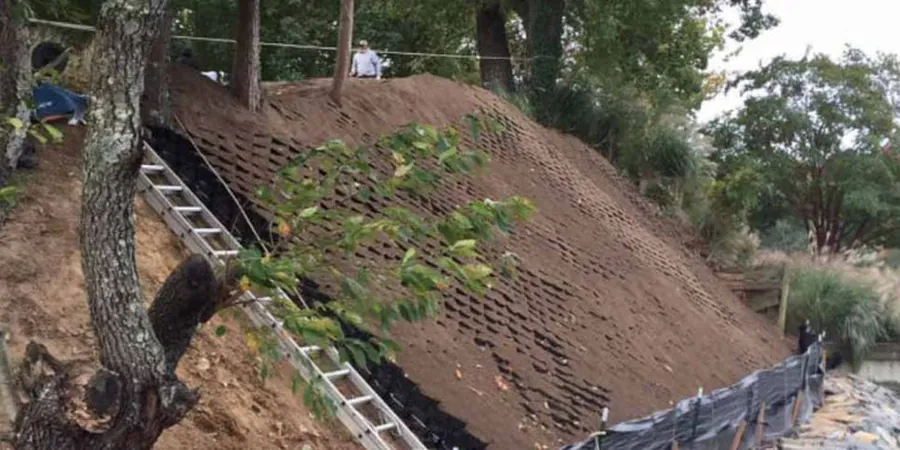
Sheet erosion on Chandler's sandy loams can reach 12 t/ha/yr during a single 50 mm storm if the surface is unprotected.
Methodology and scope
- Runoff velocity measured with dye tracing
- Sediment concentration by oven-drying at 105°C
- Soil loss tolerance set at 5 t/ha/yr per NRCS guidelines
Local considerations
Southeast Chandler near the Gila River Indian Community has coarser sands and higher infiltration rates. The northwest side around downtown has more silt and clay in the top 1.5 meters. This difference matters. Coarse soils in the southeast lose structure faster under concentrated flow. Fine-grained soils in the northwest develop surface crusting and reduce infiltration, increasing runoff. Both scenarios raise the risk of gully formation if stormwater is not managed. Our soil erosion analysis identifies which areas need immediate stabilization. We map the erosion potential using the USDA soil survey data for Maricopa County.
Applicable standards
ASTM D6460-19 (rill and interrill erosion), ASTM D422-63 (grain size), ASTM D4318-17 (Atterberg limits), RUSLE2 methodology (NRCS)
Associated technical services
RUSLE2 Parameter Determination
We run rainfall simulations and collect soil samples to compute the K, C, and P factors for your site. Results are delivered as a RUSLE2 input file ready for modeling.
Gully and Rill Erosion Survey
Field survey using RTK GPS to map existing gullies and rills. We measure cross-section geometry and calculate sediment volume loss. Recommended for arroyos in Chandler's desert fringe.
Dispersivity Testing
Pinhole test and double hydrometer test per ASTM D4647 and D4221. Identifies soils prone to tunnel erosion and piping. Critical for earth dams and retention basins in Chandler.
Vegetation and Cover Assessment
We evaluate existing ground cover using line transects and estimate the C-factor for RUSLE2. Includes recommendations for native grasses and mulching to reduce soil loss.
Typical parameters
Frequently asked questions
How much does soil erosion analysis cost in Chandler?
The typical cost for a soil erosion analysis in Chandler ranges from US$800 to US$2,170. This includes field sampling, laboratory testing, and a report with RUSLE2 parameters. The final price depends on site area and number of test locations.
What is the difference between sheet erosion and rill erosion?
Sheet erosion removes a thin, uniform layer of soil by overland flow. Rill erosion forms small channels less than 30 cm deep. Sheet erosion is harder to detect visually but can remove more soil per event. Rill erosion concentrates flow and can develop into gullies quickly if left untreated.
Does Chandler's soil type require special erosion control measures?
Yes. Chandler's sandy loams have low cohesion and are highly erodible under intense monsoon rain. Standard silt fences often underperform because the soil particles are too fine. We recommend using fiber rolls combined with native vegetation to reduce runoff velocity. Temporary seeding with sterile hybrid bermudagrass is also effective.