I was on a site near the Santan Village Parkway last month. The contractor had backfill spread across a 40,000-square-foot pad for a new retail center. He needed a geogrid specification to stabilize the subgrade before placing the base course. Without a proper spec, the geogrid would either underperform or waste material. Our team developed a tailored specification based on the actual soil conditions found during exploration. We calibrated the tensile strength, aperture size, and junction efficiency to match the underlying silty sands common in Chandler. This is not a one-size-fits-all document. Every geogrid specification we deliver references ASTM D6637 for tensile testing and considers the expected traffic loads during construction. The result is a clear, enforceable standard that the installer can follow without guesswork.
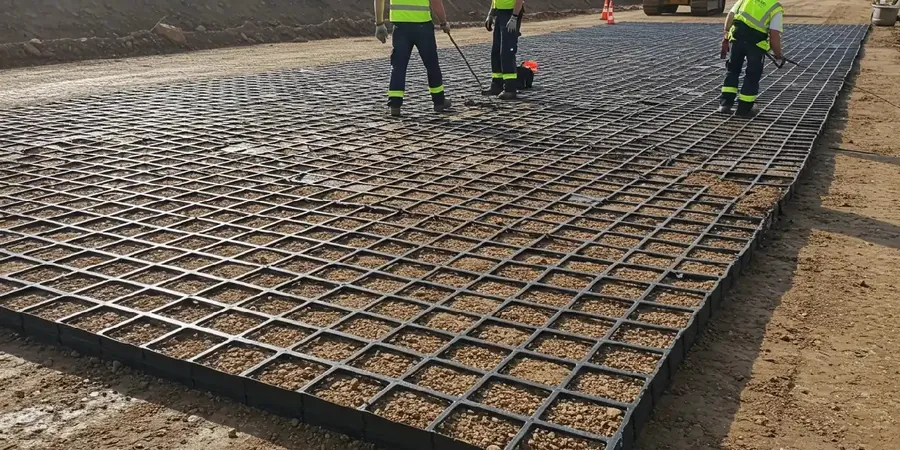
Without a proper geogrid spec, reinforcement becomes guesswork. We define tensile strength, junction efficiency, and overlap criteria based on Chandler's actual subgrade conditions.
Methodology and scope
Local considerations
The difference between the sandy soils near downtown Chandler and the clayey deposits along the Price Road corridor is significant. In the sandy zones, the main risk is particle migration through the geogrid apertures, which can cause loss of confinement over time. In the clay areas, the spec must address potential clogging of the grid openings and reduced drainage. Our geogrid specification flags these risks explicitly. We also include a pullout resistance check for anchored edges and a creep strain limit for permanent works. Ignoring these local soil contrasts leads to premature reinforcement failure or excessive deformation. In Chandler, a generic spec from another region simply does not hold.
Applicable standards
ASTM D6637 (Tensile properties of geogrid by multi-rib tensile method), ASTM D7737 (Junction efficiency of geogrids), ASTM D5321 (Direct shear test for soil-geosynthetic friction), FHWA NHI-10-024 (Mechanically stabilized earth walls and reinforced slopes)
Associated technical services
Standard Geogrid Spec
Covers base reinforcement for parking lots, access roads, and storage yards. Includes tensile strength, aperture size, and overlap details based on one soil boring per 10,000 sq. ft.
Geogrid Spec for MSE Walls
Designed for mechanically stabilized earth walls. Adds facing connection strength, long-term creep limits, and corrosion protection for steel-facing elements. Applicable to Chandler retaining walls above 6 ft.
Geogrid Spec for Soft Subgrade
For sites with CBR below 3. Includes geogrid stiffness requirements, separation layer recommendations, and construction sequencing to avoid rutting. Common near Chandler's agricultural transition zones.
Typical parameters
Frequently asked questions
What does a geogrid specification include for a parking lot in Chandler?
It includes the required tensile strength (MD and CMD), junction efficiency, aperture size, and installation damage reduction factors. It also defines the overlap distance at seams, the minimum cover thickness before loading, and the acceptance criteria for field tensile testing. The spec is tied to the actual subgrade CBR measured on your site.
How much does a geogrid specification service cost in Chandler?
The typical range is between US$400 and US$1,120. The final cost depends on the number of soil samples tested, the complexity of the reinforcement layout, and whether you need a standard spec or a full design with facing connections and creep analysis.
Can the geogrid spec be used for both temporary and permanent reinforcement?
Yes, but the reduction factors differ. For temporary works (less than 3 years), installation damage and creep factors are lower. For permanent reinforcement, we apply full long-term factors per FHWA guidelines. The spec states which category applies and references the design life required by the Chandler building department.