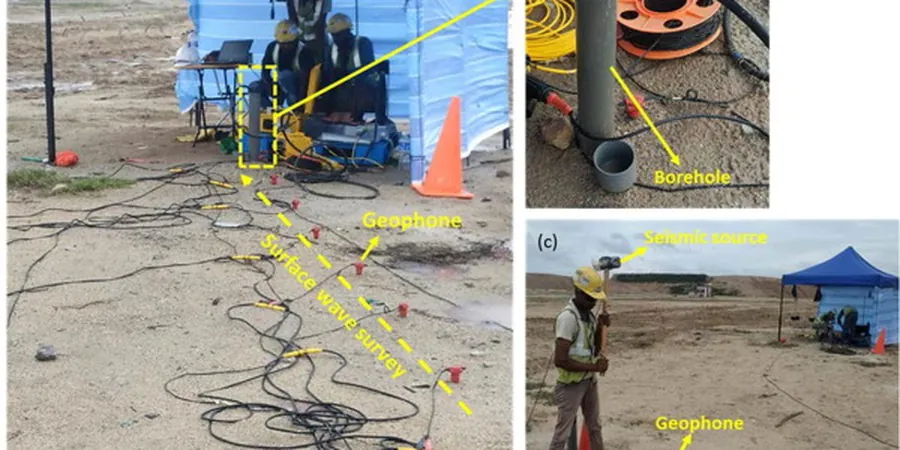
Chandler sits at an elevation of roughly 1,200 feet above sea level, with much of its urban footprint underlain by alluvial deposits from the Salt River system. Because the city lies within a region of moderate seismic hazard — the last damaging earthquake near the Phoenix metropolitan area occurred in 1887 with an estimated magnitude of 7.2 — understanding how the local soil column will amplify or dampen ground motion is critical. A proper seismic microzonation maps these variations across neighborhoods, allowing engineers to assign site classes per ASCE 7 and the IBC rather than relying on default assumptions. When the subsurface profile includes interbedded sands, silts, and cemented caliche layers, the difference between a Class C and a Class D site can shift design acceleration values significantly. Before committing to foundation details, we often recommend a resistivity survey SEV to delineate layer boundaries across large parcels, and a MASW survey to measure shear-wave velocity profiles down to 30 meters directly.
A single default site class can misrepresent seismic demand by 30 percent or more; microzonation reveals the actual ground response block by block.
Methodology and scope
Local considerations
Consider a four-story apartment complex planned near the intersection of Chandler Boulevard and Dobson Road, where shallow groundwater sits at roughly 5 meters. Without a site-specific microzonation, the structural engineer assumed Site Class C and designed for a spectral acceleration Ss of 0.3g. The geophysical survey revealed a 6-meter-thick loose sand layer with VS30 values below 360 m/s, pushing the site into Class D. The design spectra nearly doubled at short periods, requiring a complete reanalysis of the lateral system and a switch from shallow footings to drilled piers. That last-minute redesign cost the project time and budget — a scenario that a prior seismic microzonation would have prevented entirely.
Applicable standards
ASCE/SEI 7-22 (Minimum Design Loads, Site Class & Seismic Maps), IBC 2021 (Chapter 16 & 18, Seismic Design Categories), ASTM D4428/D4428M (Crosshole Seismic Testing), NEHRP Recommended Provisions (BSSC 2020)
Associated technical services
Shear-wave velocity profiling (MASW / ReMi)
Non-invasive arrays to measure VS30 and deeper velocity structure, following ASTM D4428 guidelines, with interpretation for NEHRP site class assignment.
Borehole geophysics & SPT logging
Standard penetration tests with energy measurement, coupled with downhole seismic surveys to correlate blow counts with shear-wave velocity in Chandler alluvium.
Liquefaction hazard mapping
Evaluation using the NCEER/Youd-Idriss method, including cyclic resistance ratio (CRR) from SPT and CPT data, plus factor-of-safety contours across the study area.
Site-specific response spectra
1D equivalent-linear and nonlinear ground response analyses (DEEPSOIL, Strata) to generate design spectra for each microzone, scaled to the ASCE 7 hazard level.
Typical parameters
Frequently asked questions
How is seismic microzonation different from a standard geotechnical report in Chandler?
A standard report typically assigns a single site class for the whole property and provides generalized recommendations. Seismic microzonation divides the site into zones based on measured VS30, fundamental period, and liquefaction potential, producing separate design spectra for each zone. This granularity is essential for large subdivisions or multi-building campuses where soil conditions vary across the parcel.
Does Chandler require microzonation for all new commercial buildings?
The IBC and ASCE 7 mandate site-specific ground motion procedures for certain Seismic Design Categories and site classes. While Chandler does not have its own municipal microzonation ordinance, projects with Site Class D or E, or those exceeding three stories in high seismic design categories, will almost certainly need this level of analysis to meet code. Local engineering practice also strongly recommends it for any structure with occupancy Category III or IV.
What is the typical cost range for a seismic microzonation study in Chandler?
Depending on the parcel size, number of geophysical arrays, boreholes, and laboratory tests, the cost typically falls between US$4,480 and US$16,280. A small commercial lot with two MASW lines and one SPT borehole may be at the lower end, while a full subdivision with multiple zones and liquefaction analysis approaches the upper range.
How long does a microzonation study take from fieldwork to final report?
Fieldwork — including MASW lines, SPT borings, and downhole seismic — usually takes two to four days for a typical Chandler site. Laboratory testing and data processing add another two to three weeks. The final report with microzonation maps, design spectra, and recommendations is delivered within four to five weeks from the start of fieldwork, depending on the complexity of the subsurface conditions.