Chandler sits in the Sonoran Desert, where annual rainfall barely reaches 9 inches, but monsoon storms can deliver half that total in a single afternoon. That climatic contrast drives the core challenge for road geotechnics here: the subgrade must withstand months of desiccation followed by sudden saturation. In our experience, the typical native soils — silty sands (SM) and lean clays (CL) — lose significant bearing capacity when wetted, which is why we always integrate the CBR test early in the design phase. Without that baseline, flexible pavement sections risk premature fatigue cracking within three to five years.
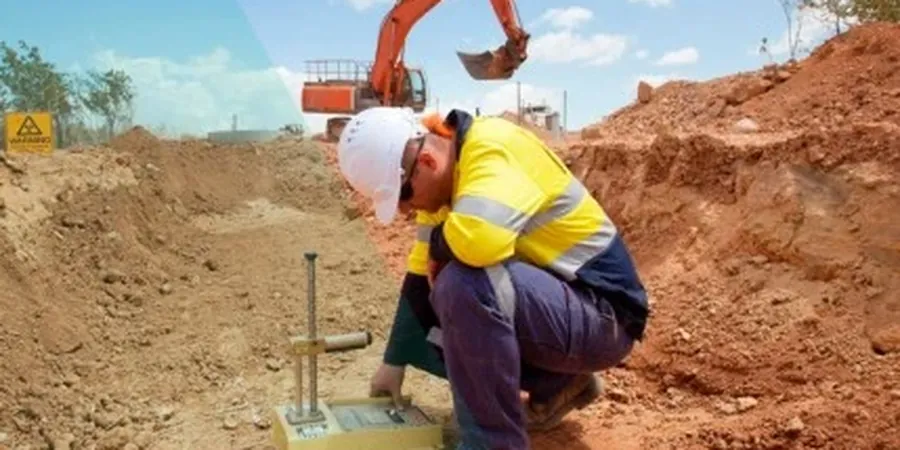
Chandler's alluvial clays can lose over 50% of their CBR when saturated, so monsoon-ready subgrade design is non-negotiable for long pavement life.
Methodology and scope
Local considerations
The upper 10 to 15 feet of Chandler's subsurface consists mostly of Holocene alluvium deposited by the Salt River system, with interbedded lenses of sand, silt, and clay. Below that lies older fanglomerate, but the near-surface variability is what causes pavement problems. When we drilled for a recent subdivision project near downtown Chandler, we encountered CBR values ranging from 6% to 18% within a 300-foot stretch. That kind of heterogeneity means a uniform pavement design across the entire site will inevitably lead to differential settlement and longitudinal cracking. We counter this by segmenting the alignment into zones with similar soil support values and designing each segment independently.
Applicable standards
ASTM D1883-21 (CBR), ASTM D4318-17e1 (Atterberg Limits), AASHTO M 145-91 (Soil Classification), ASTM D1557-12e1 (Modified Proctor), AASHTO Guide for Design of Pavement Structures 1993
Associated technical services
Subgrade Soil Characterization
Boring, sampling, and laboratory classification (USCS/AASHTO) with CBR and resilient modulus testing for each soil stratum.
Pavement Structural Design
Layer thickness calculation for flexible or rigid pavements per AASHTO 1993, including ESAL analysis and drainage adjustment.
Compaction Control Testing
Field density verification (sand cone or nuclear gauge) against modified Proctor targets to ensure embankment quality.
Expansive Soil Mitigation
Lime or cement stabilization design for high-PI clays, including dosage optimization and unconfined compressive strength verification.
Typical parameters
Frequently asked questions
Why is CBR testing critical for Chandler road projects?
CBR values in Chandler vary widely between dry alluvial sands and plastic clays. The soaked CBR test simulates worst-case monsoon saturation, which can reduce strength by 50% or more. Designing without it risks premature failure.
What is the difference between CBR and resilient modulus?
CBR is a static penetration test used for empirical pavement design. Resilient modulus (Mr) measures the subgrade's elastic response under repeated loading and is used in mechanistic-empirical methods. For Chandler soils, we often correlate Mr from CBR using the AASHTO formula Mr = 2555 x CBR^0.64.
How much does a road geotechnics study in Chandler cost?
For a typical collector road investigation, costs range between US$810 and US$4,580 depending on the number of borings, laboratory tests required, and the complexity of the subgrade profile.
How deep should borings be for pavement design?
Borings should extend at least 5 feet below the proposed subgrade elevation, or to a depth where competent material is encountered. In Chandler, we often go 10 to 15 feet deep to characterize the full active zone and check for expansive clays.