Chandler sits at roughly 1,200 feet above sea level, and its alluvial geology means many building sites sit on deep deposits of silty sands and clays that consolidate slowly under load. For projects requiring tight settlement tolerances, preloading with surcharge design offers a direct, cost-effective way to accelerate consolidation before final construction. We combine field exploration with laboratory consolidation testing to determine the exact surcharge height and drainage layout needed. A typical sequence starts with a permeability test in the field to assess drainage potential, followed by a full consolidation test on undisturbed samples to define the preconsolidation pressure. Once the design parameters are set, we monitor settlement plates and piezometers through the surcharge period to confirm performance against the predicted time-settlement curve.
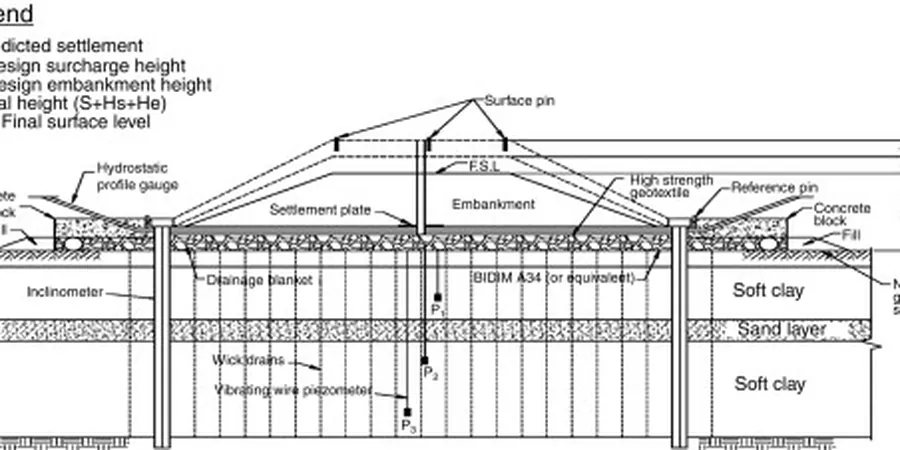
A well-calibrated surcharge program in Chandler's alluvial soils can reduce post-construction settlement by 80% or more when combined with proper drainage and monitoring.
Methodology and scope
Local considerations
The biggest risk we encounter in Chandler's preloading with surcharge design is underestimating the lateral variability of the clay layers between the downtown grid and the newer subdivisions near the Gila River Indian Community boundary. A borehole 200 feet away may show a completely different compression index. Without sufficient exploration points, the surcharge program may either under-consolidate the deeper strata (leaving residual settlement) or over-surcharge unnecessarily, delaying the project. We mitigate this by requiring at least one consolidation test per soil unit encountered and cross-referencing with SPT blow counts from adjacent standard penetration test borings to correlate compressibility across the site.
Applicable standards
ASTM D2435 (Standard Test Methods for One-Dimensional Consolidation of Soils), ASTM D1586 (Standard Penetration Test and Split-Barrel Sampling of Soils), ASTM D4220 (Preservation and Transportation of Soil Samples), IBC Chapter 18 (Soils and Foundations)
Associated technical services
Site Investigation & Parameter Determination
Boreholes, undisturbed sampling, consolidation and permeability testing to define Cv, Cc, and drainage characteristics for the specific project area.
Surcharge Design & Fill Staging Plan
Calculation of optimum surcharge height, fill placement sequence, and required drainage system (blanket drains, vertical drains) to meet the target post-construction settlement.
Field Monitoring & Performance Verification
Installation of settlement plates, piezometers, and survey monuments; periodic readings during surcharge period; final report confirming achieved consolidation and removal criteria.
Typical parameters
Frequently asked questions
How long does a preloading with surcharge program typically take in Chandler?
In Chandler's silty clay deposits, the surcharge period usually ranges from 4 to 16 weeks to reach 90% primary consolidation, depending on layer thickness, drainage conditions, and the coefficient of consolidation. Sites with vertical drains can see times under 8 weeks.
What is the typical cost for a preloading with surcharge design study in Chandler?
A full design study, including field investigation, laboratory consolidation testing, and monitoring plan, typically falls between US$750 and US$2,300. The final cost depends on the number of boreholes and the depth of compressible layers.
Can preloading with surcharge be combined with vertical drains in Chandler?
Yes. For deep compressible deposits (over 20 feet), combining prefabricated vertical drains with surcharge is standard practice. The drains reduce the drainage path, accelerating consolidation significantly. We design the drain spacing and surcharge height together to achieve the target time-settlement curve.
What settlement criteria do you use for post-construction acceptance?
We typically design for total post-construction settlement under 1 inch for structural foundations, with differential settlement limited to 1/2 inch over a 40-foot span. These values are verified by monitoring settlement plates during the surcharge period and extrapolating to the end of primary consolidation.