Chandler's rapid growth from a small farming community into a major suburban center of the Phoenix metropolitan area has placed significant demands on its shallow foundations. The city's geology, dominated by alluvial fan deposits from the San Tan Mountains and deep layers of basin-fill sediments, means bearing capacity can vary dramatically within a single lot. A plate load test (PLT) provides a direct measurement of the soil's load-settlement behavior under a rigid plate, offering site-specific data that empirical correlations from SPT or CPT alone cannot guarantee. In our experience, this test is especially valuable for verifying the design assumptions for footings on the compacted fills common in Chandler's newer subdivisions, where moisture control during construction is critical. Before interpreting the plate results for a mat foundation, it is common to cross-check with a detailed study of consolidation settlement to separate immediate from long-term deformations.
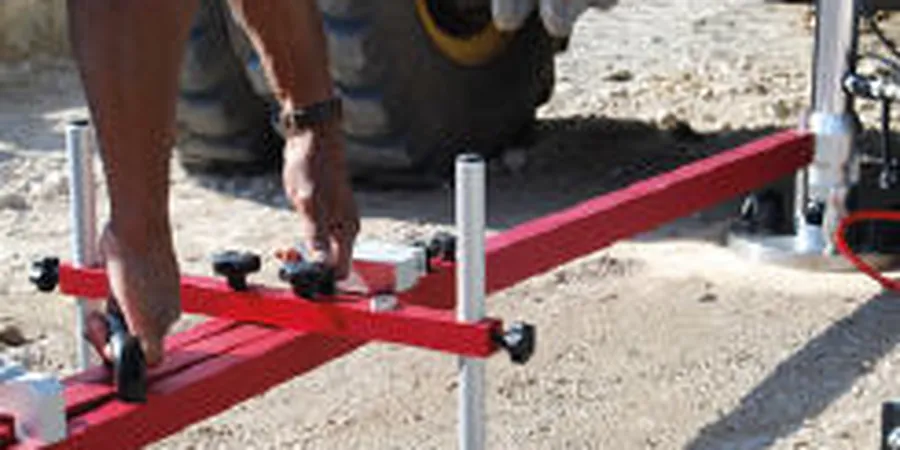
A plate load test gives you the actual load-settlement curve of the soil, not an estimate. It filters out the noise of variable alluvial deposits.
Methodology and scope
- Modulus of subgrade reaction (k_v) for slab-on-grade design
- Ultimate bearing capacity at 5% of plate diameter settlement
- Modulus of elasticity (E_s) from the reloading curve
Local considerations
The plate load test rig for Chandler sites consists of a hydraulic jack, a calibrated load cell, and a reaction frame ballasted with concrete blocks or anchored with helical piles. The biggest risk we see on site is not the equipment itself but the interpretation. A single plate test only samples the soil to a depth of about two plate diameters. Below that, a loose layer or a soft clay seam can go undetected. In Chandler, where the old river channels of the Santa Cruz Wash cut through the alluvium, this is a real concern. We always recommend at least two tests per building pad to capture spatial variability. The second most common issue is not pre-loading the plate properly. A full loading-unloading-reloading cycle is essential to measure the true elastic modulus, not just the initial plastic deformation of the disturbed surface soil.
Applicable standards
ASTM D1196-20, IBC 2021 Section 1806.2, ASCE 7-22 (Chapter 12, Seismic Site Class for bearing)
Associated technical services
Bearing Capacity Verification
Direct measurement of ultimate bearing capacity and allowable soil pressure using a 30-inch plate, with full load-settlement curves reported to the design engineer.
Subgrade Reaction Modulus for Slabs
Dedicated test for k_v values used in slab-on-grade and mat foundation design, following the reloading cycle method to match service-level loading.
Quality Control on Compacted Fill
PLT on structural fill pads to confirm that compaction achieves the design modulus, particularly on the silty sands (SM) and clays (CL) common in Chandler's development areas.
Typical parameters
Frequently asked questions
What is the difference between a plate load test and a CBR test?
A CBR test measures the penetration resistance of a 2-inch piston into a compacted sample at a controlled rate, giving a relative strength index mainly used for pavement design. A plate load test (PLT) measures load-settlement behavior under a rigid plate up to failure or design load, providing direct bearing capacity and modulus of subgrade reaction. For foundations in Chandler, PLT is the relevant field test; CBR is used for subgrade and base course evaluation.
How deep does the plate load test actually test the soil?
The test's zone of influence is approximately two times the plate diameter. For a 12-inch plate, that is about 24 inches of depth. For a 30-inch plate, about 60 inches. This is why we caution against relying on a single shallow test when a deeper soft layer might exist. In Chandler, where the alluvial profile can change within 5 feet, we often combine the PLT with a cone penetration test (CPT) to check for deeper weak zones.
How much does a plate load test cost in Chandler?
The realistic cost range for a standard plate load test with a 30-inch plate, one loading-unloading-reloading cycle, and a written report is between US$830 and US$1,110 per test location for Chandler projects. The final price depends on site access, mobilization distance, and the number of tests required. Volume discounts apply when testing multiple pads on the same site.