A slab-on-grade project near Chandler Boulevard cracked before the concrete reached full cure. The homeowner had skipped a swell-consolidation test. That's what happens when clay-rich soils in the Sonoran Desert meet moisture changes. For any foundation in Chandler, understanding the expansion potential of the underlying material is non-negotiable. We measure free swell, swelling pressure, and volumetric change under controlled conditions. These data feed directly into slab reinforcement design and moisture barrier specs. Before placing any concrete, a thorough expansive soil evaluation prevents the kind of differential movement that leads to costly repairs. The test sequence typically starts with index properties, then moves to oedometer-based swell tests under expected surcharge loads. For sites with existing cracks, we also recommend a complementary asentamiento diferencial study to quantify ongoing movement.
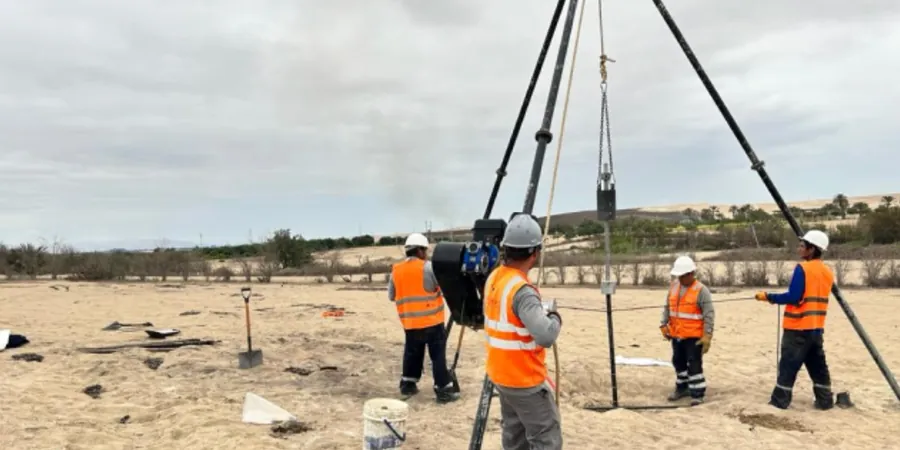
High-plasticity clays in Chandler routinely show free swell above 8 percent and PI values exceeding 40, demanding deep foundation alternatives.
Methodology and scope
- Free swell percent under 1 psi seating load
- Swelling pressure at constant volume (psf or kPa)
- Vertical strain under wetted conditions
- Expansion index per UBC 18-2 when specified
Local considerations
ASCE 7 and the International Building Code require site-specific characterization for expansive soils when the expansion index exceeds 20. In Chandler, the risk is amplified by the depth of the active zone — typically 4 to 6 feet — and the presence of desiccation cracks that concentrate moisture migration. A partial evaluation that omits wetting cycles under load can underestimate swelling pressure by a factor of two. We've seen post-tensioned slabs lift 3 inches in one monsoon season because the design assumed half the actual swell potential. The evaluation must include at least three oedometer tests at representative depths within the active zone, plus classification tests on each sample. Ignoring the cyclic nature of wetting and drying in Chandler's arid climate leads to recurring damage and litigation.
Applicable standards
ASTM D4318 (Atterberg Limits), ASTM D4546 (One-Dimensional Swell), IBC Chapter 18 (Expansive Soils), ASTM D2487 (Unified Soil Classification)
Associated technical services
Index Property Testing (Atterberg Limits, Sieve, Natural Moisture)
Classification tests to identify CH, CL, or MH soils. Liquid limit, plastic limit, and percent fines determine expansion potential category per ASTM D4318 and D2487.
Oedometer Swell-Consolidation Tests
Free swell, swelling pressure, and vertical strain under incremental loads per ASTM D4546. Reports include swell percent vs. time curves and collapse potential if applicable.
Expansion Index (EI) per UBC 18-2
Standardized 24-hour swell test on compacted specimens at optimum moisture. Results classify soil as very low (<20), low (20-50), medium (51-90), high (91-130), or very high (>130).
Typical parameters
Frequently asked questions
How long does an expansive soil evaluation take in Chandler?
Index tests take 2-3 business days. Oedometer swell tests require 5-7 days for a full wetting cycle under load. A complete evaluation with report typically takes 7-10 business days from sample delivery.
What is the cost range for expansive soil testing in Chandler?
The typical range for a standard evaluation (index properties plus three oedometer swell tests) is between US$610 and US$1,780. Volume discounts apply for multi-lot subdivisions or phased developments.
Can expansive soil evaluation be done on a vacant lot before design?
Yes, and it's strongly recommended. A pre-design evaluation allows the structural engineer to select foundation type (post-tensioned slab, deep piers, or stiffened raft) based on measured swell potential rather than assumed values. Borings should extend at least 6 feet below the active zone.
What happens if the swelling pressure exceeds the foundation design capacity?
The slab or footing must be redesigned to resist the measured pressure, or the soil must be treated via moisture conditioning, chemical stabilization with lime or cement, or removal of the expansive layer and replacement with non-expansive fill. The evaluation report includes recommended mitigation options.